
HACCP News
Under the Food Safety Modernization Act (FSMA), food manufacturers must have track and trace systems in place under the Food Traceability Rule. The original compliance date was January 20, 2026, but the FDA has since extended it to July 20, 2028. The following will discuss what this means for food safety in terms of manufacturers, food processors, and co-packers.
The FSMA 204 Deadline Has Been Extended to July 2028
The FDA has extended the compliance date for the Food Traceability Rule from January 20, 2026 to July 20, 2028 – a 30-month extension. The FDA proposed the delay to give supply chain partners adequate time to coordinate technology, standardize Key Data Elements (KDEs), and establish critical tracking workflows. Late 2025 Congressional legislation further directed the agency not to enforce the rule prior to July 20, 2028.
Importantly, the core requirements of the Food Traceability Rule have not changed – only the enforcement timeline has shifted. And while federal enforcement is pushed to 2028, major buyers and retail chains (such as Walmart) have continued implementing traceability standards on accelerated schedules of their own, so track & trace data-sharing requirements are actively moving forward across commercial supply chains regardless of the federal deadline.
What Are Track and Trace Systems?
Also known as traceability systems, food safety track and trace systems help to ensure food safety. As the name suggests, these systems track the food from farm to table.
Track and trace technologies play an important role in various production facilities. They monitor the products through every step of the supply chain, from beginning to end.
Why Is Traceability Important?
There are numerous reasons why traceability is important. The main reasons include:
- To comply with regulations and ensure food safety standards to ensure requirements are met. (These vary depending on organization type and geographical location).
- Track and trace systems are vital in preventing foodborne illnesses and protecting consumers. Additionally, they quickly identify any sources of contamination so the affected products can be removed from the market promptly.
Reducing the impact of outbreaks is a good enough reason to prioritize traceability. However, doing so also affects businesses. Unsurprisingly, brands that respond to safety issues before a limited number of incidents occur, often have better reputations. By building consumer confidence, brands create long-lasting relationships with purchasers who can trust that safety issues and regulation standards are met.
How Track and Trace Systems Work
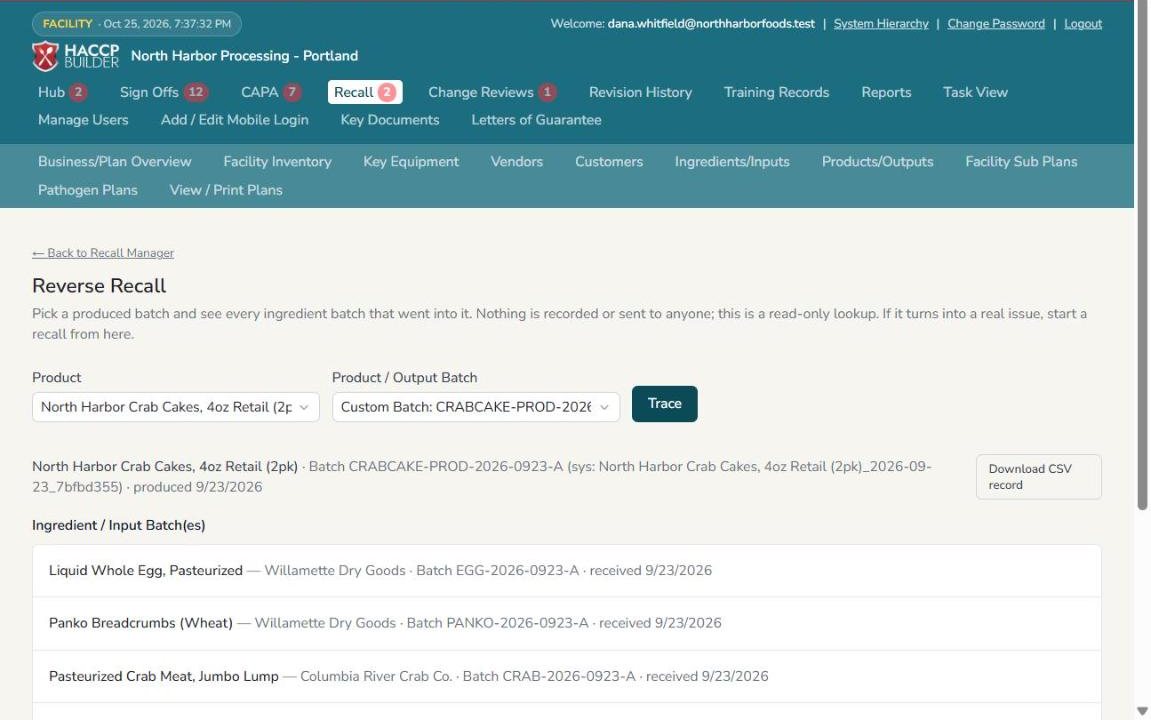
These systems track the movement of food and ingredients through each step of production, processing, and distribution. They document the names and addresses of suppliers and customers, the product(s) and date of delivery, and the quantity/volume of the shipments. This is done by using various processes. Including but not limited to cloud-based receiving logs and records, barcodes, RFID tags, and other tracking mechanisms to ensure real-time data can be provided.
These detailed records provide important information to everyone who plays a part in the supply chain along with the USDA/FDA. This includes Key Data Elements (KDEs) associated with specific Critical Tracking Events (CTEs). The data should be provided to the USDA/FDA within a specified window, usually 24 hours.
Who Uses These Systems?
If a company handles food products, it is safe to assume that track and trace systems are integral to their operations. This includes those who make food products and run production facilities. For example, farmers, holders, processors, manufacturers, warehouses, retailers, and co-packers. A few exemptions to the Food Traceability Rule can be seen more in-depth here.
Manufacturers
Manufacturers use track and trace systems to manage raw materials and other components as they go through the supply chain. The system helps reduce defects while also ensuring they meet requirements every step of the way.
The track and trace systems also help manufacturers account for specific details. This includes the source of the product(s), and which ingredients are used throughout the process. It also includes what kind of environment(s) it is processed in.
Processors
To protect public health, track and trace systems will aid a team (often called a Recall Action Team) to follow a program. This program involves developing an automated track and trace system tracking, documenting, implementing, and maintaining traceability.
To ensure proper protocols are followed, this should be standard practice for all food processors. In the event of a recall, processors must follow a pre-established program and/or an automated traceability solution. This way, everyone involved knows their roles, limiting wasted time and resources. A track and trace system will be able to identify the source of the contamination. It will also provide insight into possible holes in the safety practices and/or protocols to enable corrective actions reducing risk.
Co-Packers & Warehouses
“Co-packing” is the term used for when a specialized company is hired to package another company’s food products. It is seen as a highly effective form of outsourcing. It is cost-effective and aids in increasing or decreasing production depending on the market.
Adapting quickly to the market is a major advantage for any business. Especially, for those in the food industry. Therefore, to compile product data, co-packers, and warehouses use different technologies to facilitate the process.
This should include track and trace systems. Such systems provide the tools necessary for easy monitoring. For example, the accurate labeling of processed products. As mentioned above, this is especially useful in the case of product recalls.
With IoT being increasingly used by manufacturers, supply chain data is collected and is easier to track. In turn, this aids warehouses and co-packers to have vital information about the stock they possess. More importantly, it will enable them to take action as needed promptly.
Proactive Planning To Be Prepared
For farmers, suppliers, and mass-market businesses, implementing track and trace systems should not wait until the last second. Everyone they do business with, from supply chain partners to technology partners, should be informed. It’s critical to be on the same page about all the changes the systems will inspire.
The extended deadline doesn’t mean you can wait – many retail partners are already moving faster than the federal timeline requires. It is better to be prepared well in advance to limit the amount of stress associated with the deadline. Track and trace like this is one part of a complete food safety software platform, not a standalone tool. If more information on track and trace systems is needed, contact HACCP Builder.
We will answer all your questions and concerns to ensure you are prepared well ahead of the FSMA 204 deadline. We can be reached at (866) 577-4030 ext. 800 or via email at [email protected]. You may also leave us a message and we will get back to you shortly. In the meantime, feel free to book a free demo!